

Top 10 Cosmetic Packaging Types for Global Buyers
Cosmetic Packaging is more than a container: it protects formulas, supports product use, and shapes how a brand feels in a customer’s hand. A glass serum bottle, a compact with a tight-fitting lid, or a tube that dispenses cleanly can each solve different problems. For global buyers, the right choice depends on the product, supply chain, target market, and budget. There is no universal winner.
The environmental stakes are also substantial. The OECD’s Global Plastics Outlook reports that packaging represented 40% of global plastic waste in 2019. UNEP’s 2023 report, Turning off the Tap, describes pathways that could reduce plastic pollution by 80% by 2040 through system-wide changes. These figures cover plastics broadly, not beauty packaging alone. Still, they make material choice, refill options, and end-of-life planning difficult to ignore.
This guide compares ten common packaging types, including bottles, jars, tubes, pumps, compacts, and sachets. It looks at practical details: leak risk in transit, ease of dispensing, compatibility with formulas, decoration options, and material recovery. Small choices matter. A pump may protect a product from repeated contact, yet add components that complicate recycling. A jar can look premium, but customers may need a clean spatula. Trade-offs remain. Buyers should verify supplier specifications and local recycling guidance before committing, since packaging that works well in one market may not work as well in another.
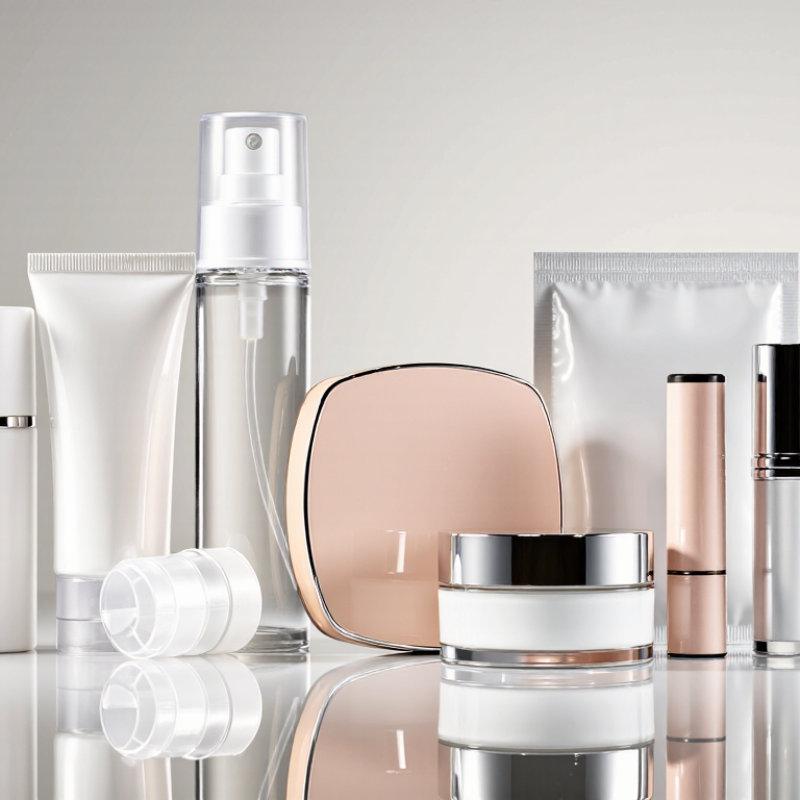
How Cosmetic Packaging Protects and Presents Beauty Products
Cosmetic packaging does two jobs at once: it shields a formula and helps customers understand how to use it. A tight pump can reduce repeated finger contact, while an opaque bottle limits light exposure for light-sensitive ingredients. Closures matter, too. A loose cap can invite leaks during shipping. Yet packaging cannot compensate for an unstable formula; compatibility and stability testing still matter.
The market’s scale makes these choices significant. Grand View Research estimated the global cosmetic packaging market at USD 34.98 billion in 2023, in its Cosmetic Packaging Market Size report. That figure describes market value, not packaging performance. For practical selection, buyers should assess material compatibility, dispensing accuracy, seal integrity, and protection from light, oxygen, and moisture. Small details count. A pump that leaves product trapped inside may frustrate users and create avoidable waste.
Packaging also carries an environmental cost. The US Environmental Protection Agency reported that containers and packaging generated 82.2 million tons of municipal solid waste in the United States in 2018, or 28.1% of the total. This is not cosmetics-only data, but it shows why pack weight and recyclability deserve attention. Refill formats can reduce material use, though they must remain easy to clean and refill. A glossy finish may look refined; it does not prove the pack protects better. Buyers should test real product and transport conditions before choosing.
Bottles, Jars, and Tubes: Three Essential Packaging Types
Cosmetic bottles suit lotions, toners, and cleansers that need controlled dispensing. A pump can reduce mess, while a narrow neck helps limit spills during filling. Match the closure to the formula’s thickness; a pump designed for thin liquid may struggle with a dense lotion. Check that the bottle and formula remain compatible through storage and transport. Small tests matter.
Jars provide wide access for creams, balms, and thicker masks. Buyers can inspect the fill level and use a spatula, but open-mouth formats expose more product to air and fingers. That can affect cleanliness in everyday use. A liner or inner seal may help protect the contents before opening, though it adds material and another component to manage.
Tubes are useful for targeted application and easy carrying. Their flexible walls let users squeeze out product, and a narrow tip can help control the amount. Some formula may remain near the sealed end. Plastic and laminate tubes also differ in flexibility and barrier performance, so test them with the actual formula. Include repeated squeezing and shipping conditions in trials. Packaging decisions are rarely perfect; a lighter format may travel efficiently but feel less sturdy in hand.
Top 10 Cosmetic Packaging Types for Global Buyers
Typical example fill sizes for common retail packaging formats
Bottles, jars, and tubes cover a broad range of everyday cosmetic products. The values shown are representative example sizes, not market averages; actual capacities vary by product and supplier.
Pumps, Droppers, and Sprayers: Three Controlled-Dispensing Types
Pumps, droppers, and sprayers help control how much product leaves a package. Grand View Research’s Cosmetic Packaging Market report valued the global market at USD 32.5 billion in 2023 and projected a 5.5% compound annual growth rate from 2024 to 2030. This figure covers cosmetic packaging overall, not dispensing formats alone. For buyers, the practical choice depends on formula, dose, and user experience. A pump suits many lotions and liquid cleansers. A dropper offers more measured application for thin oils or serums. Sprayers spread fine mists across a wider area.
Tips: Test the actual formula, not just water. Check dose consistency, leakage after transport, and whether the dip tube reaches the final product. A thick cream may struggle through a narrow pump. A fine sprayer may clog. Small details matter.
These formats have trade-offs. Pumps can leave product behind, while droppers may expose contents to air during use. Sprayers can deliver uneven coverage if the actuator or formula is poorly matched. Request samples and run repeated-use tests with the intended container. It is easy to focus on appearance; performance after weeks of handling deserves equal attention.
Compacts, Sticks, Sachets, and Airless Packs: Four Specialized Types
Compacts suit pressed powders and color products, where a mirror and secure hinge make touch-ups practical. A refillable pan can extend the outer case’s useful life, but hinges and mirrors complicate material separation. The OECD’s Global Plastics Outlook (2022) estimates that packaging generated 40% of global plastic waste in 2019.
Small, precise, portable.
Sticks work well for solid balms and targeted application; check that the tube advances smoothly and protects the product from heat. Sachets offer low-cost sampling and measured doses, but tiny multilayer packs are difficult to sort and recycle. Airless packs limit product contact with air and can help dispense viscous formulas with less residue, though results depend on pump design and formula testing. Not every formula needs one.
The trade-off deserves attention. UNEP’s Turning off the Tap (2023) estimates that system-wide changes could cut plastic pollution by 80% by 2040; packaging design is only part of that effort. For buyers, compare material weight, refill options, component count, and local recycling access—not appearance alone. A sleek pack may still be hard to recover.
How Global Buyers Compare Materials, Compliance, and Supply Needs
Global buyers often compare ten familiar formats: glass bottles and jars, PET bottles, HDPE bottles, PP jars, airless pumps, squeeze tubes, aluminum tins, paperboard cartons, refill pouches, and makeup compacts. Each solves a different supply problem. Glass feels substantial, but adds weight and breakage risk. PET and HDPE are lighter; PP suits many jars and closures. Pumps and compacts add components, so buyers should check whether local sorting systems can handle them.
Material choice is only one test. OECD’s Global Plastics Outlook reports that packaging generated 40% of global plastic waste in 2019. That figure makes material reduction and end-of-life planning practical purchasing questions, not just design details. Ask suppliers for material specifications, component weights, recycled-content evidence, and samples from production runs. Check whether labels, pumps, liners, and closures separate cleanly. Small parts matter.
Compliance and supply checks should travel together. Request migration or compatibility test results for the actual formula, plus documentation for every market where the product will be sold. Confirm dimensions, color tolerances, minimum order quantities, lead times, and backup material options in writing. A beautiful sample is not a supply plan. The awkward reality: a recyclable bottle can still be hard to recycle when its pump uses mixed materials. UNEP’s 2023 report, Turning off the Tap, also calls for reducing unnecessary packaging and improving reuse and recycling systems. Buyers should verify local collection conditions; assumptions travel poorly.
| Packaging type | Common materials | Typical product fit | Buyer advantages | Key trade-offs and checks | Supply and compliance considerations |
|---|---|---|---|---|---|
| Glass bottle | Soda-lime glass; sometimes specialty glass | Fragrance, facial oils, serums, and other liquid products | Good barrier properties; glass generally resists many cosmetic ingredients and can have a premium appearance. | Heavier and more breakable than plastic; check bottle weight, closure fit, coating durability, and transit protection. | Confirm compatibility with the formula and dispensing system. Recycling access and accepted colors vary by market; decorations and attached components may affect processing. |
| PET bottle | Polyethylene terephthalate (PET) | Shampoo, lotion, cleanser, and other personal-care liquids | Lightweight and impact-resistant compared with glass; commonly used for clear or colored containers. | Check chemical compatibility, stress cracking, product discoloration, and whether the selected grade provides sufficient barrier performance. | Ask whether the bottle uses PET and whether labels, colorants, sleeves, and closures are compatible with the intended local recycling stream. |
| HDPE bottle | High-density polyethylene (HDPE) | Shampoo, conditioner, body wash, and selected household-style personal-care products | Durable, lightweight, and available in opaque formats that help limit light exposure. | Usually less transparent than PET; check fragrance or oil compatibility, wall strength, and dispensing performance. | Confirm the resin identification and evaluate closure and label materials together. Collection and recycling availability depend on the destination market. |
| PP jar | Polypropylene (PP) | Creams, masks, balms, scrubs, and thicker formulations | Lightweight and suitable for many wide-mouth formats; can be made in a range of shapes and colors. | Open-mouth use can expose product to fingers and air; test sealing, leakage, odor transfer, and formula compatibility. | Check the jar, lid, liner, and any inner seal as a complete pack. Material collection and sorting options vary by country. |
| Glass jar | Soda-lime glass, often paired with a metal or plastic closure | Face creams, balms, masks, and premium skin-care products | Rigid, reusable in some consumer settings, and offers a substantial feel. | Higher shipping weight and breakage risk; confirm closure sealing, liner compatibility, and protective packing requirements. | Evaluate the full packaging assembly, including lid, liner, labels, and coatings. Do not assume all components will be recycled together. |
| Airless pump pack | Commonly a combination of PP, PE, PET, or other plastics; some designs include multiple components | Serums, lotions, creams, and products where controlled dispensing is desired | Can help limit product exposure to air during use and dispense measured portions; useful for some sensitive formulations. | More components and a higher unit cost than a basic bottle may apply; test priming, dose consistency, residual product, and formula compatibility. | Request a component and material breakdown. Multi-material construction may complicate sorting or recycling, depending on local systems. |
| Standard pump bottle | Typically a PET or HDPE bottle with a PP pump and other small components | Liquid soap, lotion, cleanser, and body-care products | Convenient controlled dispensing; bottle and pump formats can be sourced in a range of sizes. | Check pump output, lock function, leakage, spring construction, and performance with the product’s viscosity. | Test the assembled pack under shipping conditions. Ask suppliers for pump material details because mixed materials can affect end-of-life handling. |
| Dropper bottle | Glass or plastic bottle with a pipette, bulb, and closure made from combinations of glass, elastomers, and plastics | Facial oils, concentrated serums, and other low-viscosity products | Allows small-volume dispensing and supports controlled application for suitable formulas. | Not ideal for every viscosity; assess dose repeatability, leakage, bulb and formula compatibility, and consumer handling. | Check all materials in contact with the formula and validate transport sealing. The multi-part assembly may require separation for recycling. |
| Flexible tube | PE or laminated plastic structures; some tubes include a barrier layer | Cleanser, hand cream, sunscreen, and travel-size products | Lightweight, squeezable, and generally resistant to breakage in transit. | Barrier needs vary by formula; check seal integrity, cap fit, product evacuation, and compatibility with printing or decoration. | Ask for the complete layer structure. Some all-PE designs may be compatible with specific recycling systems, while mixed-material laminates can be harder to process. |
| Aerosol container | Usually aluminum or steel can, with a valve, actuator, and formulation-specific components | Sprays, mists, and selected foam products | Provides pressurized dispensing and can deliver a fine spray or foam, depending on the formulation and valve. | Requires specialized filling and pressure testing; consider flammability, transport restrictions, and user safety where applicable. | Check applicable pressure-container, transport, labeling, and dangerous-goods requirements for each destination market. Requirements depend on the product and propellant. |
Buyer note: Material suitability, labeling rules, recycling access, and transport requirements vary by formula and destination market. Confirm the applicable requirements with qualified packaging, regulatory, and logistics partners before production.
Related Posts
-
Ultimate Guide to Choosing the Right Cosmetic Packaging for Your Brand
-
2026 Best Trends in Cosmetic Packaging Design Innovations
-
How to Choose and Use Skin Bottles for Better Skincare Results
-
Top Cosmetic Packaging Trends Transforming the Beauty Industry Today?
-
Top 10 Glass Bottle Packaging Solutions for Industry Buyers?
-
What Are the Top Lip Gloss Tubes for Global Buyers?


